
Behavioural activation: activities that matter, between appointments
· By The Orekio team
Updated
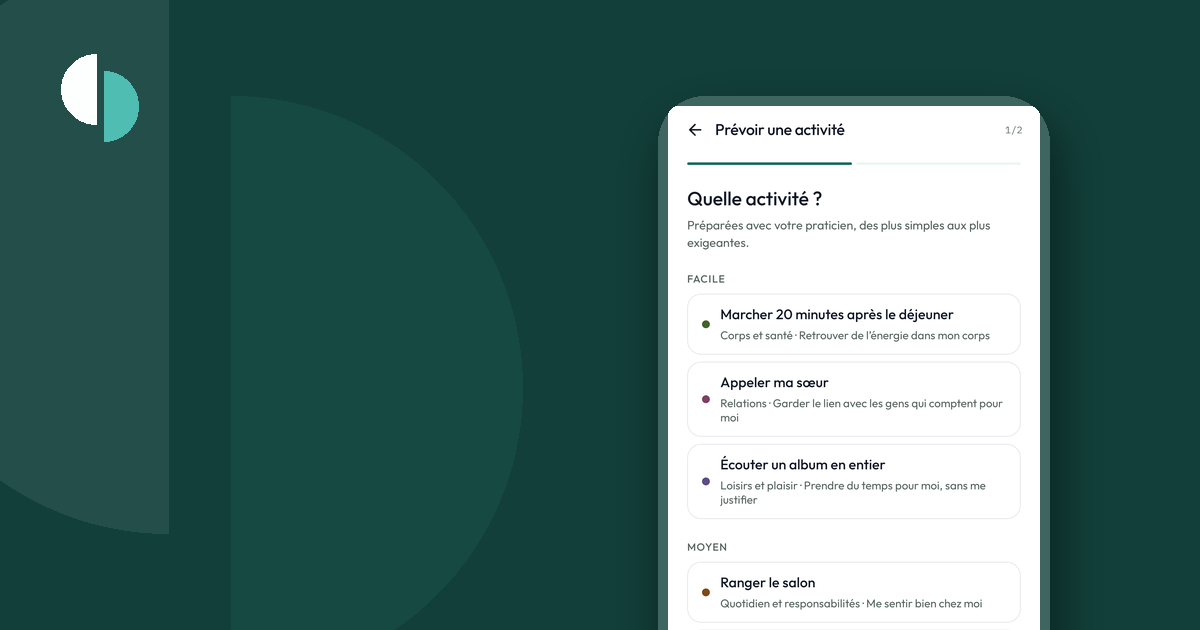
Behavioural activation is one of the most concrete approaches to entrust to a patient whose mood is low. When people are struggling, they sometimes do fewer things, and what used to do them good drifts away. The method offers a way back through action: choosing with you small activities that matter to them, planning them in their week, doing them, then noting what they brought.
The principle
The reference manual, the BATD-R (Lejuez et al., 2011), follows a simple order:
- The patient's life areas, for example relationships, work, leisure, health, daily life;
- What matters in each, put by the patient in their own words;
- Activities linked to what matters, ranked from easiest to hardest, starting with the easiest;
- A day and a time for each: the manual calls this a key aspect of the treatment.
Activities start from what matters to the patient, not from a ready-made list. And an activity that feels too heavy is broken down: the first step of a bike ride may simply be checking that the bike is in good shape.
What it brings
For the patient, the method turns a vague intention ("I should get out more") into a plan that fits them: a precise activity, a day, a time, one step at a time. Noting afterwards the pleasure felt and the sense of having accomplished something helps them spot what does them good and what gives them a sense of moving forward.
For you, it is concrete material for the consultation: what was done, what got stuck, what brought pleasure, in the patient's own words. The appointment starts from their actual week rather than from memory.
A recognised method
Evaluated in more than a hundred trials, behavioural activation does as well as the other psychotherapies for adult depression (Cuijpers et al., 2026), CBT included (Uphoff et al., 2020). Its strength lies in its simplicity: in the COBRA trial, workers without psychotherapy training delivered it with results equivalent to CBT provided by professionals (Richards et al., 2016). NICE recommends it as a first-line treatment and, for less severe depression, as guided self-help: the patient moves forward between appointments, while the practitioner encourages them and reviews progress with them.
What Orekio does with it, and what belongs to you
In Orekio, behavioural activation is a module you open when you judge it useful; the patient finds it under the name "My activities". In consultation, you build with them, life area by life area, what matters and the activities attached to it, each ranked Easy, Medium or Hard. You can also offer them general ideas to complete the list.
On their phone, even offline, the patient sees their week at a glance: one dot per activity, filled when done, outlined when planned. They plan an activity for a day, with a time they are encouraged to set, and can receive a regular reminder at the time chosen. When they tick it, they can rate from 0 to 10, if they wish, the pleasure felt and the sense of having accomplished something.
At the next appointment, if they have agreed to share, you find a clear report, week by week and life area by life area: what was planned, what was done, their ratings and their words. The patient, for their part, sees what they have achieved, put simply ("3 done, 4 upcoming"), with no score and no judgement: an activity that could not happen remains something to pick up together. The clinical reading stays yours; Orekio is designed as a digital logbook serving the consultation (see About).
In practice
Two or three easy activities, in an area where the patient feels at ease, are often enough to start. The list grows over the appointments. The shared review is what makes the tool valuable: an activity left aside, an unexpected pleasure rating, are all starting points for the consultation. The module combines with Daily log and, when the work turns to thoughts, with Beck's thought records.
Sources
- Lejuez CW, Hopko DR, Acierno R, Daughters SB, Pagoto SL. Ten year revision of the brief behavioral activation treatment for depression: revised treatment manual. Behav Modif. 2011;35(2):111-161. https://doi.org/10.1177/0145445510390929
- Cuijpers P, Ciharova M, Tong L, Liu Y, Sprenger AA, Miguel C, Karyotaki E, Harrer M. Behavioral activation for depression: a comprehensive systematic review and meta-analysis. Clin Psychol Rev. 2026;128:102783. https://doi.org/10.1016/j.cpr.2026.102783
- Uphoff E, Ekers D, Robertson L, et al. Behavioural activation therapy for depression in adults. Cochrane Database Syst Rev. 2020;7(7):CD013305. https://doi.org/10.1002/14651858.CD013305.pub2
- Richards DA, Ekers D, McMillan D, et al. Cost and Outcome of Behavioural Activation versus Cognitive Behavioural Therapy for Depression (COBRA): a randomised, controlled, non-inferiority trial. Lancet. 2016;388(10047):871-880. https://doi.org/10.1016/S0140-6736(16)31140-0
- National Institute for Health and Care Excellence. Depression in adults: treatment and management (NG222). 2022. https://www.nice.org.uk/guidance/ng222