
The sleep diary: what it is for between two appointments
· By The Orekio team
Updated
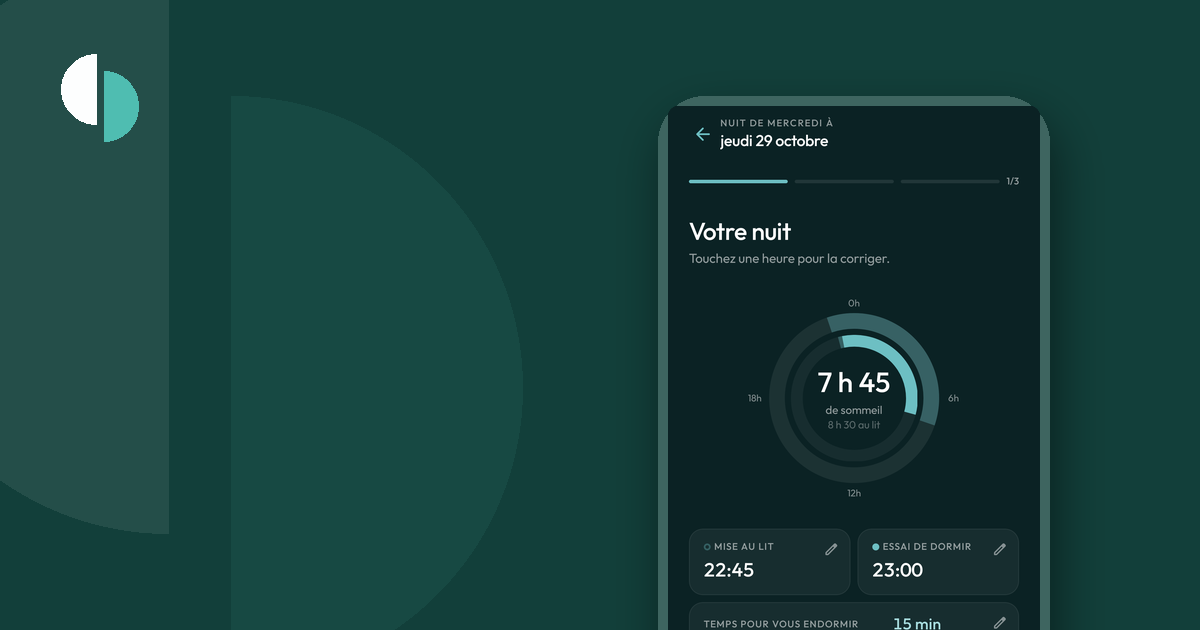
The sleep diary is one of the simplest tools to hand over to a patient, and one of the most useful for the consultation that follows. It asks them for one to two minutes each morning, and it gives you a concrete picture of the nights between two appointments, where memory alone stays approximate.
What it records
A sleep diary notes, day after day:
- bedtime and rising time;
- the estimated time to fall asleep;
- the number and length of night-time awakenings;
- a free note on how the night felt;
- depending on the case, naps, coffee or alcohol intake, medication taken.
These items are those of the Consensus Sleep Diary, the reference version established by an expert panel (Carney et al., 2012). Over two weeks, these lines form a pattern: a phase shift, fragmentation, time spent in bed far greater than time actually asleep. These are markers the patient and you can look at together, from data they entered themselves.
Why keep it every morning
Filled in afterwards, in the waiting room, the diary loses most of its value: it becomes a reconstruction. Kept every morning, it captures the night as it was experienced, without smoothing. That is what makes it the foundation of cognitive behavioural therapy for insomnia, recommended as first-line treatment (American Academy of Sleep Medicine, 2021): the sleep window is calculated directly from the records.
Keeping the diary often shifts attention from a diffuse feeling ("I slept badly") to a finer observation ("I woke up once, around 4 a.m., and fell back asleep").
What Orekio does with it, and what belongs to you
In Orekio, the sleep diary is a module you open when you judge it useful. The patient fills it in every morning from their phone, even without a network, with a fixed-time reminder if you have set one, which they can shift. At the next appointment, you find the full history.
Orekio displays this data, and stops there. What appears on screen is a neutral history: times, durations, the patient's words. Orekio calculates no sleep score, gives no signal about a short night and compares to no norm. The clinical reading belongs to you: phase shift, sleep hygiene, whether a specific treatment is indicated.
This is a choice: Orekio is designed as a digital logbook, not as a medical device. Its role is to make available; concluding belongs to you.
In practice
To introduce the diary with a patient, it is often enough to explain that it is a support for the next appointment rather than a test, and that a few lines a day are enough. The first two weeks serve as a baseline; what follows lets you look together at the effect of the adjustments decided in consultation.
Sources
- Carney CE, Buysse DJ, Ancoli-Israel S, Edinger JD, Krystal AD, Lichstein KL, Morin CM. The consensus sleep diary: standardizing prospective sleep self-monitoring. Sleep. 2012;35(2):287-302. https://doi.org/10.5665/sleep.1642
- Edinger JD, Arnedt JT, Bertisch SM, et al. Behavioral and psychological treatments for chronic insomnia disorder in adults: an American Academy of Sleep Medicine clinical practice guideline. J Clin Sleep Med. 2021;17(2):255-262. https://doi.org/10.5664/jcsm.8986