
Naming what I feel: why the right word matters in consultation
· By The Orekio team
Updated
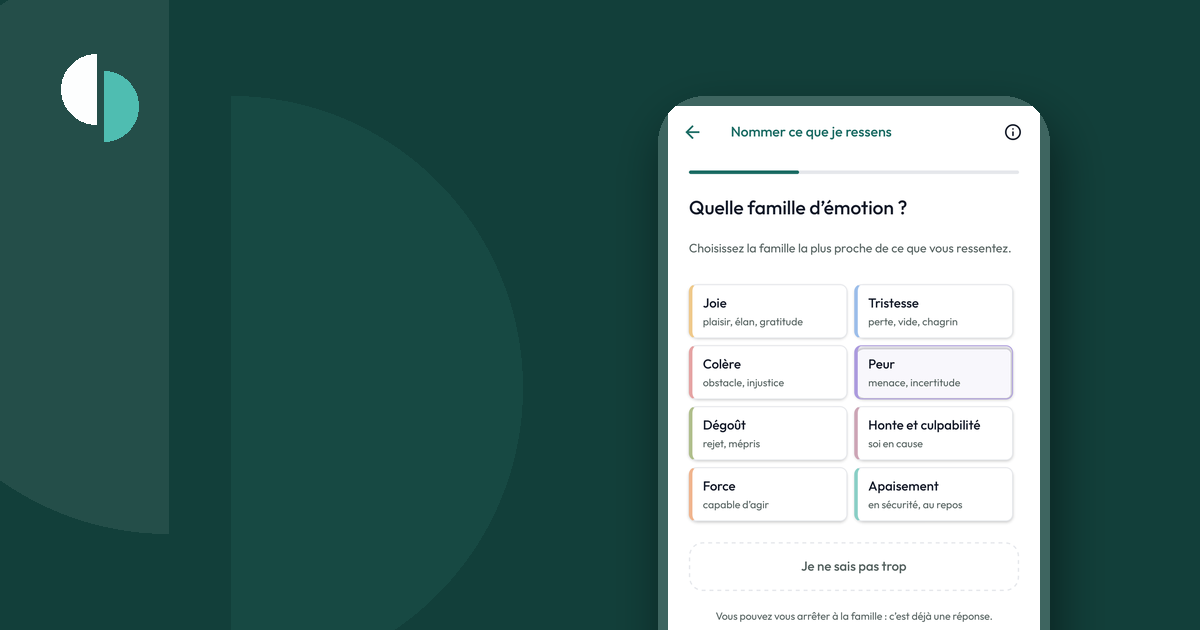
Putting a precise word on what you feel changes how you can work on it. Moving from "I feel bad" to "I feel discouraged" or "I feel humiliated" opens different paths. Emotion wheels are visual aids designed for that: a few families at the centre, finer and finer shades toward the outside.
What it brings
Naming an emotion accurately, what is called emotional granularity, is associated in adults with better regulation (Barrett et al., 2001). In adolescents, the literature is thinner and its conclusions remain cautious (Dunning et al., 2025). An aid of this kind is often offered:
- when emotional vocabulary is poor or undifferentiated ("stressed", "annoyed" for everything);
- to adolescents and to people who struggle to tell apart what they feel;
- to distinguish close feelings (anger, frustration, resentment; sadness, disappointment, shame);
- ahead of work on thoughts, for example Beck's thought records.
The models
Several models coexist: Plutchik's wheel (eight primary emotions, with intensities and combinations), the Geneva Emotion Wheel, a research instrument, or Gloria Willcox's feeling wheel (1982), arranged in concentric circles and stemming from transactional analysis. They have neither the same origin nor the same use, but none is a measuring instrument: they are maps. Orekio relies on Willcox's wheel, the simplest for a patient to read, in eight families.
What Orekio does with it, and what belongs to you
In Orekio, Naming what I feel is a module you open when you judge it useful. Between two appointments, the patient picks a family, then a shade as fine as they wish, notes an intensity from 1 to 5, the context and, if they want, a few words. If they cannot find a word, they can save an entry without a word. At the next appointment, you find these entries as they are, in the order they wrote them.
Orekio does not summarise mood, draws no interpreted curve and gives no signal. You read the patient's words. As with the other modules, this is consistent with its status as a digital logbook, not a medical device (see About).
In practice
The module suits short, repeated use: a few entries a week, rather than a detailed journal. It is often opened together with Daily log and, for moments of high intensity, with the safety plan and the Grounding module.
Sources
- Willcox G. The Feeling Wheel: a tool for expanding awareness of emotions and increasing spontaneity and intimacy. Transactional Analysis Journal. 1982;12(4):274-276. https://doi.org/10.1177/036215378201200411
- Barrett LF, Gross J, Christensen TC, Benvenuto M. Knowing what you're feeling and knowing what to do about it: mapping the relation between emotion differentiation and emotion regulation. Cognition and Emotion. 2001;15(6):713-724. https://doi.org/10.1080/02699930143000239
- Dunning DL, Wright G, Bennett MP, Knight R, Nook EC, Dalgleish T. What role does emotional granularity play in adolescent depression and anxiety? A scoping review. J Adolesc. 2025;97(8):2033-2047. https://doi.org/10.1002/jad.70028